BCS Mission
Empowering students to maximize their potential.
BCS GOALS

Connect
At BCS, we believe in the power of relationships. As the saying goes, "People don't care how much you know until they know how much you care." Our staff members teach more than content; they teach students. Educational research (e.g., John Hattie's Visible Learning) consistently shows that positive teacher-student relationships have a high impact factor (d=0.52) on student achievement.
Read More
Students are unique individuals with their own histories, personalities, strengths, challenges, and futures. We aspire to lead with care, compassion, acceptance, and humility. By connecting deeply, we lower the "affective filter," making students feel safe to take academic risks.
Influence
Our faculty and staff members aren't just employees; they are leaders charged with positively influencing the lives of students and one another. Collective Teacher Efficacy—the shared belief that our staff can positively impact student learning—is the number one factor in student achievement (d=1.57).
Read More
We prioritize collaboration, cooperation, and commitment over control or compliance. We believe ALL can contribute to their worlds in meaningful ways. True influence is transformational, guiding students to internalize high standards rather than simply obeying rules.
Achieve
Through meaningful relationships, creative leadership, and real-world opportunities, we challenge students to pursue their potential. Achievement is not just about test scores; it's about closing the gap between a student's current ability and their ultimate capability.
Read More
Whether in the classroom, on the athletic field, or in performance activities, accountability matters. We hold ourselves to high standards of work ethic, perseverance, and growth, ensuring every student has the scaffolding they need to experience rigorous success.
Effective Policies and Procedures
We recognize that for our corporation to operate safely, effectively, and efficiently, members of the BCS community must abide by thoughtfully crafted, systemic, and common-sense policies and procedures. These frameworks create the predictability necessary for a thriving educational environment.The Power of Being a "Warm Demander"
Google Doc
What is a Warm Demander?
Coined by Judith Kleinfeld, the term "Warm Demanders" describes educators who expertly blend high expectations for student achievement with unconditional positive regard. They operate in the "authoritative" quadrant of teaching—high warmth paired with high control/structure. This approach prevents the pitfalls of being overly permissive (high warmth/low demand) or authoritarian (low warmth/high demand).
- Valued and Respected: Students understand their teacher believes in their potential and champions their success, recognizing them as capable individuals.
- Challenged and Supported: Academic rigor is deliberately high. Students are given productive struggle, but receive the necessary scaffolding (Vygotsky's Zone of Proximal Development) to succeed.
- Accountable for their Learning: Clear expectations and consistent, non-punitive follow-through create a sense of personal responsibility and internal locus of control.
Five Pillars of the Warm Demander Approach
1. Build Trust through Consistency
2. Teach Self-Discipline explicitly
3. Cultivate an Abundance Mindset
4. Scaffold for Success
5. Embrace Failure as Data
Why Become a Warm Demander?
- Improved Academic Achievement
- Increased Student Motivation
- Stronger Teacher-Student Relationships
- Reduced Behavioral Issues
- Greater Teacher Satisfaction
Warm Demander Scripting
Instead of: "You need to do this because I said so."
Try: "I'm pushing you to redo this paragraph because I know how smart you are, and this draft doesn't show your best thinking yet. Let's look at the rubric together."
Further Reading
What's Good is What Works
Google Doc
Great teaching is truly an art. In other arts – painting, sculpture, the writing of great novels – great masters leverage a proficiency with basic tools to transform the rawest of material into some of the most valued assets in society. This alchemy is astounding because the tools often appear unremarkable to others. Drawing heavily from Doug Lemov's Teach Like a Champion, we believe in the relentless execution of fundamentals.
The Artisan Behind the Art
Great art relies on the mastery and application of foundational skills, learned individually through diligent study. You learn to strike a chisel with a mallet. You refine the skill with time, learning at what angle to strike and how hard to drive the chisel.
Years later, observers will likely talk about what school of thought your work represents. They are far less likely to reflect on the proficiency with the chisel that made the vision possible. Behind every artist is an artisan. In education, the "chisel" is our daily routines: how we ask questions, how we transition between activities, and how we frame feedback.
Unlocking Latent Talent
Our aim as educators must be to become the types of teachers who unlock the latent talent waiting in our students. There is often a temptation to evaluate instructional tools based on how clever they are, how they align with a trending philosophy, or how fun they are to use.
Instead, we must evaluate them based on student achievement data. Many techniques that truly work (like repetitive retrieval practice or clear, standardized routines) can at first seem mundane. But remember the track record of the lowly chisel—in practiced hands, it creates striking faces out of stone.
The Classroom is the Unit of Success
The evidence is clear: in the hands of a champion teacher, the simplest tools yield remarkable results. In most schools, there are classrooms where unruly students suddenly pull out notebooks and work like scholars. The successful outlier classroom is a more frequent phenomenon than the successful outlier school.
The unit at which technique varies is the classroom, and you alone control your technique. By focusing on micro-adjustments to your pedagogy—where you stand, how you pause after a question, how you frame a correction—you gain massive macro-level results.
Creating a Strong Classroom Culture
Google DocA strong culture isn't accidental. It is engineered through deliberate habits, routines, and high expectations. Click a principle below to navigate.

Discipline
When most people use the word discipline, they treat it as administering consequences (a verb). It is better used as a noun: the state of being able to do something the right way. At the core of this definition is teaching. We must explicitly teach students the successful way to organize a binder, enter a room, or participate in a discussion.
Management
Management is the process of reinforcing behavior by consequences and rewards. While highly effective classrooms absolutely need management systems (like token economies or structured demerits) for efficiency and clarity, management cannot sustain itself without the other elements of positive culture.
Without inspiration and trust, a death spiral ensues: students become desensitized to consequences and Machiavellian about rewards. Rely on management to build the track, but use inspiration as the engine.
Influence
Influence is your capacity to cause someone to choose to do what you ask, regardless of the consequences attached. It involves leveraging relationships, tone, and pacing to make students *want* to align with your vision.
The biggest paradox about influence is that it supports freedom. The more we have the power to exercise responsible influence to keep students safe and focused, the more freedom and autonomy we can give them in their academic exploration.
Inspiration
True inspiration involves getting students to believe they want to succeed, and want to work for it for intrinsic reasons rather than external rewards. Belief is a powerful, lasting motivator.
Share stories of past students who overcame struggles. Connect today's mundane objective to tomorrow's massive real-world goal. Paint a vision of their future that they want to inhabit.
Engagement
Champion teachers give students plenty to say "yes" to, busily engaging them in productive, positive, and rapid-fire work.
A busy student doesn't have time to be a disruptive student. By keeping the pacing tight and the activities varied (moving from 'turn-and-talk' to 'stop-and-jot'), kids lost in their work start to think they are inherently productive members of society.
The 4 Questions of Quality Instruction
Adapted from DuFour's Framework
Doc
These four questions must drive every instructional planning session to ensure equity and rigor.
-
1
What do my students need to know? Identifying essential standards, unzipping the curriculum, and setting crystal clear learning targets.
-
2
How will I know they know it? Designing common formative assessments, exit tickets, and daily checks for understanding.
-
3
What if they don't know it? Planning systematic, timely, and directive Tier 2 & 3 interventions without removing them from core instruction.
-
4
What if they already know it? Providing extended learning, deeper DOK tasks, and enrichment to continually challenge high achievers.

PLC Overview & Application
These four foundational questions form the bedrock of Professional Learning Communities (PLCs). They shift our focus from teaching to learning, ensuring every instructional decision is driven by student data and equitable outcomes.
- Proactive Planning: Aligning on essential standards and anticipating student misconceptions before they occur.
- Targeted Support: Building safety nets (Tier 2/3 interventions) directly into the curriculum timeline.
- Continuous Growth: Never capping a student's potential by preparing robust enrichment strategies for high achievers.
Learning Objectives
Teacher clarity is one of the most powerful learning interventions.

The Power of Clarity
According to educational researcher John Hattie, when teachers are highly clear about what their students need to learn (Learning Intentions) and how they will know they've learned it (Success Criteria), the resulting effect size equates to 0.75—nearly two years of student learning in one school year.
We must substitute "What will my students do today?" (activity-focused) for "What will my students learn today?" (outcome-focused).
The Planning Sequence
Always plan backward. Start with the end goal in mind.
- Objective (Learning Intention): Define exactly what the student will know or be able to do. Ensure it aligns with state standards.
- Assessment (Success Criteria): Plan a short, rigorous daily assessment (e.g., an Exit Ticket) that definitively proves mastery of the objective.
- Activity: Only *after* the assessment is built do you design the engaging instructional activities that lead up to it.
Objective Action Verbs & Activities
1 Remembering (Knowledge)
Recalling or recognizing knowledge, facts or concepts from long-term memory.
define, describe, identify, label, list, match, name, outline, recall, select, state, locate
- Make a timeline of historical events
- Recite a poem or important writing (e.g., Gettysburg Address)
- Match vocabulary words to their textbook definitions
2 Understanding (Comprehension)
Constructing meaning from instructional messages; demonstrating fundamental grasp of material.
illustrate, defend, compare, distinguish, estimate, explain, classify, generalize, interpret, paraphrase, summarize
- Compare two opposing political viewpoints
- Explain a scientific phenomenon in your own words
- Summarize the main idea of a chapter in 3 sentences
3 Applying (Application)
Using ideas, procedures, and concepts to solve new, real-world problems.
implement, organize, dramatize, solve, construct, demonstrate, discover, manipulate, modify, predict, calculate
- Construct a diorama or working model demonstrating a physical process
- Use an algebraic formula to calculate the trajectory of a projectile
- Apply a grammatical rule to edit a peer's draft
4 Evaluating (Analysis/Evaluation)
Breaking material into constituent parts, making judgments based on specific criteria.
rank, assess, critique, check, test, judge, deconstruct, differentiate, troubleshoot, argue, validate
- Critique the validity of a media source based on bias indicators
- Troubleshoot a broken line of code in a software program
- Debate the ethical implications of a historical decision
5 Creating (Synthesis)
Reorganizing diverse elements to form a new, functional, and original pattern or structure.
generate, plan, compose, develop, create, invent, organize, design, devise, formulate, propose
- Write an original short story employing specific literary devices
- Design a business plan to solve a local community issue
- Formulate a novel hypothesis for a science experiment
Circulate
Circulation isn't just about proximity; it's a strategic tool to maintain engagement, silently correct off-task behavior, and actively assess student work in real-time.

Break the plane
The "plane" is the imaginary line 5 feet in front of the board. Break it within the first 5 minutes. Teaching entirely from the front creates a passive audience; moving among them creates active participants.
Full access required
You must be able to reach any student's desk easily without interrupting your teaching flow. If getting anywhere requires shuffling or apologizing, students have established a psychological "no-fly zone."
Move systematically
Circulate universally and impersonally. Don't just target the "behavioral" side of the room. Use unpredictable pathways so students can't predict when you'll reach them, maintaining universal engagement.
Position for Influence
Always square up and remain facing the class. Leverage student blind spots: the most powerful position is standing just behind a student's shoulder—you can see their work and the class, but they must face forward.
Cold Call
Systematically calling on students regardless of whether they raise their hands.
Cold Calling is often misunderstood as a "gotcha" technique. When implemented correctly, it is a profoundly positive, predictable structure that tells students, "I care about your opinion, and I expect you to have something valuable to say." It levels the playing field so that extroverts do not dominate the intellectual space.
The Four Purposes of Cold Call
1. Checking for Understanding
If you only assess the enthusiastic volunteers with raised hands, you suffer from a "false positive" bias, tricking yourself into thinking you’ve achieved mastery across the whole room.
2. Culture of Engaged Accountability
Students learn that raising hands is a way to signal a specific contribution, not a shield to avoid participation. Every student is a participant, every day.
3. Efficient Pacing
Waiting agonizing seconds for a hand to raise wastes valuable instructional time and drains momentum. It is simpler, faster, and more dynamic to immediately direct a question to a specific student.
4. Backstopping Your Ratio
If you pair a "Turn and Talk" or independent writing time with the knowledge that a Cold Call will follow, students engage much more rigorously during the independent phase.
No Opt Out
Google DocA sequence that begins with a student unable to answer a question should end with that same student answering the question as often as possible. Eliminating the "I don't know" escape hatch proves that your classroom is a place where everybody learns.
Four Basic Formats of "No Opt Out"
Teacher: "What's the capital of Ohio, Sam?" Sam: "I don't know."
Teacher: "It's Columbus. Sam, what is the capital?" Sam: "Columbus."
Teacher: "Sam, what's the capital?" Sam: "I don't know."
Teacher: "Maria, help him out." Maria: "Columbus." Teacher: "Right. So Sam, what's the capital?" Sam: "Columbus."
Teacher: "Sam, who was the 16th president?" Sam: "I don't know."
Teacher: "He delivered the Gettysburg Address and is on the penny." Sam: "Abraham Lincoln."
Teacher: "Sam, what is 8 times 7?" Sam: "I don't know."
Teacher: "Maria, can you tell Sam how to figure it out?" Maria: "Do 8 times 5 which is 40, then add two more 8s." Teacher: "Sam, use Maria's strategy." Sam: "56."
Formative Assessments
Google DocContinuous pedagogical tools to gauge understanding and pivot instruction.

1. Circulate & Track
Don't just observe; carry a clipboard. Track specific errors as students work. If you see the same error 4 times, stop the class and do a real-time reteach.
2. Targeted Cold Call
A predictable, positive way to foster engagement. Call on a mix of low, medium, and high performers to get an accurate cross-section of class understanding.
3. Entrance/Exit Tickets
Quick 3-to-5-minute written responses to definitively summarize learning. Grade them in piles (Got it / Sort of got it / Missed it) to immediately plan tomorrow's warm-up.
4. Universal / Choral Response
All students respond simultaneously. This creates massive participation ratio and allows the teacher to do a sweeping visual check of the entire room in seconds.
5. Anonymous Quiz
Give a rigorous quiz with NO names allowed. It uncovers raw, class-wide gaps without the pressure of individual grading or embarrassment.
No Apologies
Maintaining unyielding high expectations in language and practice.

Apologies for Content
There is no such thing as inherently boring content; enthusiasm is highly contagious. Teacher doubt puts us at risk of watering down the curriculum. Avoid:
- Assuming it's boring: "I know this grammar stuff is dull, but let's just get through it."
- Blaming an outside entity: "I wouldn't teach you this, but it's on the state test."
- Diluting it: Making material accessible by lowering the standard rather than increasing the scaffolding.
Flip the Script:
"This material is fantastic because it's genuinely challenging! Once you master this algorithm, you'll know more math than most adults walking around today. Let's conquer it."
Apologies for Students
Assuming something is too hard for some students is a dangerous trap born of low expectations. Setting the bar unapologetically high raises a student's self-perception.
Kids naturally respond to challenges; they require pandering only if adults pander to them. When we let them off the hook, we unintentionally communicate, "I don't think you are capable." Explode expectations!
Flip the Script:
"I know you can do this, so I'm not going to let you off the hook. I'm going to stick with you. It's perfectly okay to be confused on the first try, but we are going to figure it out together right now."
Retrieval Practice
Learning is not just about putting information *into* a student's brain (encoding); it is deeply dependent on forcing the student to pull the information *out* (retrieval). Frequent, low-stakes quizzing, flashcards, and "brain dumps" literally alter neural pathways, making future retrieval faster and more durable.
Spaced & Interleaved
Cramming doesn't work long-term. "Spacing" means returning to a topic weeks after it was first taught. "Interleaving" means mixing different types of problems together in a single assignment, forcing the brain to determine *which* strategy to use, not just how to use it.

The SUCCESs Model
Adapted from "Made to Stick" by Chip and Dan Heath. Ideas that are remembered share these traits.
S
Simple
Strip the lesson to its core. Don't hide the main point under trivia.
U
Unexpected
Violate their schemas. Use mystery or a counter-intuitive fact to grab attention.
C
Concrete
Avoid abstract jargon. Use sensory language and physical analogies.
C
Credible
Use vivid details, statistics, or let students test the idea themselves.
E
Emotional
Make them feel something. Connect the content to their identity or empathy.
S
Stories
Stories act as mental flight simulators, preparing the brain to act.
Growth Mindset & Productive Struggle
Pioneered by Carol Dweck: Praising the process over the person.

Growth Mindset
The belief that intelligence, character, and creative abilities are not fixed at birth, but can be developed through dedication, explicit strategy use, and hard work.
- Praise Effort, Not Traits: Instead of "You're so smart," say "Your hard work on this draft really paid off."
- Embrace challenges as brain-growing opportunities.
- View feedback not as personal criticism, but as a map for improvement.
Productive Struggle
Actively grappling with complex tasks. It is the "sweet spot" (Zone of Proximal Development) where students are challenged enough to build new neural pathways, but supported enough not to succumb to utter frustration.
- Like muscles growing through heavy lifting, brains grow through strenuous thought.
- Requires effortful practice and making mistakes.
- Develops long-term grit and resilience.
In a typical classroom, the teacher works harder than the teacher works harder than the students. They talk more, write more, and summarize more. A master teacher flips this paradigm, strategically forcing students to do the vast majority of the intellectual work.
Participation Ratio
A measure of who is participating and how often. Maximizing it means moving away from a single student answering a question to all students answering simultaneously.
Strategies to boost Participation:
- Everybody Writes: Have students jot down thoughts before opening the floor.
- Turn and Talk: 100% of the class speaks to a partner.
- Cold Call: Keeps everyone on their toes.
Think Ratio
A measure of the rigor of the engagement. Are they just recalling a basic fact, or are they synthesizing, analyzing, and explaining the "why"?
Strategies to boost Think Ratio:
- Unbundle: Break one big question into smaller questions passed around the room.
- Feigned Ignorance: Play dumb ("Wait, I don't get it, why did you add 4?").
- Stretch It: When a student gives the right answer, immediately ask "How?" or "Why?".

1. Strategic Planning
Illusion of speed comes from meticulous preparation.
- Bite-Sized Chunks: Break 40-minute lectures into four 10-minute cycles of instruction and application.
- Do Nows: Have work on the desk the second they enter so learning starts before the bell.
2. Delivery Techniques
Keep the momentum moving forward.
- Work the Clock: "You have 3 minutes for this paragraph. Go." Use visible countdown timers.
- Tight Transitions: Practice passing papers or moving to groups so it takes 15 seconds, not 3 minutes.
3. Real-Time Adjustments
Adapt instantly to the room's energy.
- Speed Up: Cut 3 planned share-outs down to 1 if they got the concept easily.
- Slow Down: Use a "Stop & Jot" if you see blank stares, forcing everyone to process the thought.
Impactful Technology Use (ITU)
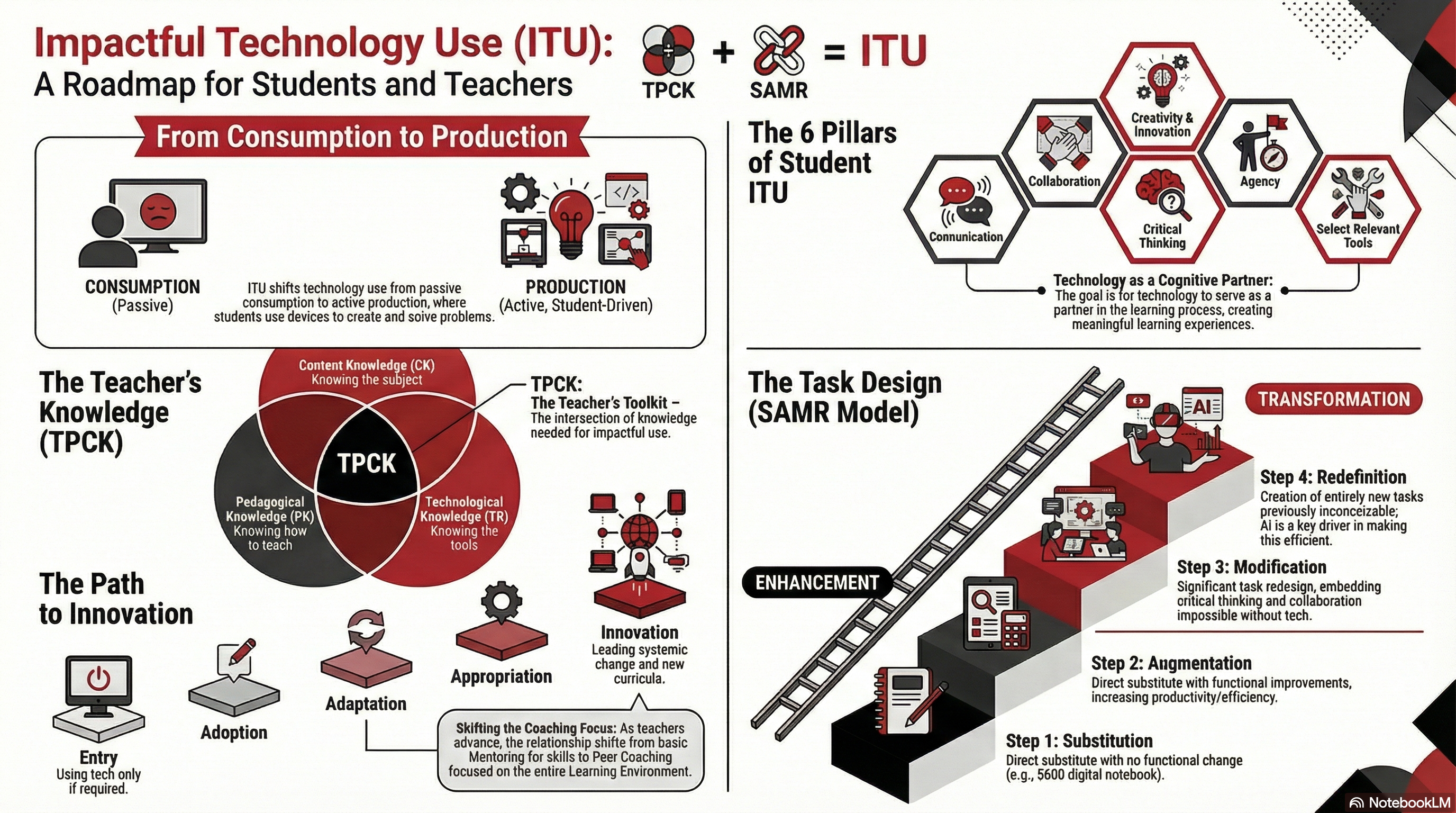
A Roadmap for Students and Teachers
Instructional technology serves to amplify, rather than replace, effective pedagogical practices. Intentional classroom integration transitions students from passive consumers to active creators, utilizing devices as authoring tools anchored in established high leverage frameworks. Ultimately, academic growth and meaningful learning are driven by intentionally designed strategies that foster connections, inspire influence, and ensure equitable opportunities for student achievement.
From Consumption to Production
The fundamental shift required for ITU is moving technology use from passive consumption to active, student-driven production. We want our students to use devices not just to absorb information, but to create, build, and solve problems. By intentionally focusing on production, technology serves as a cognitive partner in the learning process, creating deeply meaningful learning experiences.

The 6 Pillars of Student ITU
Critical Thinking
Using digital tools to analyze data, evaluate the credibility of varied sources, and logically solve complex, real-world problems rather than just finding quick answers.
Creativity & Innovation
Designing, building, and publishing original digital content (such as videos, podcasts, code, or models) to express ideas and solutions uniquely.
Collaboration
Working seamlessly with peers, experts, and global communities in shared digital workspaces to co-construct knowledge and broaden perspectives.
Communication
Articulating thoughts clearly and purposefully adapting the message and medium to targeted audiences across various digital platforms.
Digital Citizenship
Demonstrating safe, legal, and ethical behavior online, while actively and respectfully contributing to a positive digital community environment.
Learner Agency
Leveraging technology to set personal academic goals, monitor progress independently, and customize the learning journey based on individual needs.
The Frameworks Behind the Design
TPACK Model
The Teacher's Toolkit
To facilitate Impactful Technology Use, educators utilize the TPACK (Technological Pedagogical Content Knowledge) framework. The "sweet spot" is understanding how tools and techniques uniquely mesh to teach specific content effectively.
Knowledge about various technologies, ranging from low-tech (pencils) to digital (computers, software).
Deep knowledge about the processes and practices of teaching and learning (methods, assessment, classroom management).
Knowledge about the actual subject matter that is to be learned or taught.
-
TK (Technological Knowledge):
Knowing the tools, including technical skills and software ("I know technology").
-
PK (Pedagogical Knowledge):
Knowing how to teach, encompassing instructional knowledge and strategies.
-
CK (Content Knowledge):
Knowing the subject area, key concepts, and real-world applications ("I know my subject").
SAMR Model
Task Design
A four-level taxonomy that serves as a framework to guide our thinking when we design instructional tasks integrating technology tools, moving from mere enhancement to complete transformation.
Redefinition
TransformationCreation of entirely new tasks previously inconceivable. AI is often a key driver here.
Modification
TransformationSignificant task redesign, embedding critical thinking and expanding the audience.
Augmentation
EnhancementDirect substitute with functional improvements, increasing productivity/efficiency.
Substitution
EnhancementDirect substitute with no functional change (e.g., a simple digital notebook).
The Path to Innovation
Shifting the coaching focus: As teachers advance, the relationship shifts from basic mentoring for skills to peer coaching focused on the entire learning environment.
Entry
Using tech only if required.
Adoption
Direct instruction utilizing basic tech tools.
Adaptation
Independent tech use for familiar tasks.
Appropriation
Tech used seamlessly as a tool to achieve goals.
Innovation
Leading systemic change and new curricula.
ITU Roadmap
Evaluation Info
Rubrics, templates, and essential information for the evaluation process.